

By: Fredwill Hernandez
The 123rd National Association of Music Merchants (NAMM) Show, which ran from Sun., Jan. 25 through Sun., Jan. 28, returned for the third time in person without any COVID-19 restrictions with “mixed emotions.” Many attendees were disappointed with the show’s size and turnout, while others like myself were just glad NAMM returned to its regular January dates, even if it was back with baby steps, in hopes future NAMM shows will eventually regain momentum and return to their glory days.
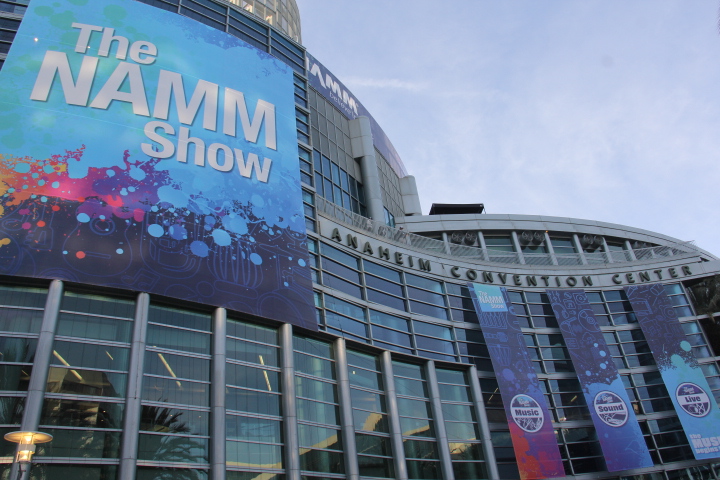
Absent from the show were companies like Gibson Brands, PRS, Fender, UA, Marshall, Presonus (Fender), KRK (Gibson), and countless others who, according to NAMM in 2021, experienced a 50% drop from the 7,000 brands that exhibited in 2020 during the last in-person show before the pandemic. A notable difference this year was the size of some previous show booths, their location, and even though the floor plan allowed more space between booths – a pandemic precaution – it was obvious there was much less foot traffic. There were 115,000 attendees in 2020, and this year there were 62,000 attendees (15,289 more than last year) and 1,600 exhibitors (400 more also than last year), representing roughly 3,500 brands versus 7,000 brands that exhibited in 2020, the last year the show was held pre-pandemic.
On the flip side, companies like Shure [Mics], Wolff Audio, Warm Audio, Lynx Studio Technology, Amphion Loudspeakers Ltd., Klawitter Design [KD], and a few others took advantage of the in-person show’s return to personally interact with attendees and its customers.
For a third straight year, there was a “buzz” surrounding Warm Audio’s booth. This year, it was based on their new and very impressive “blue” WA-1B tube optical compressor.
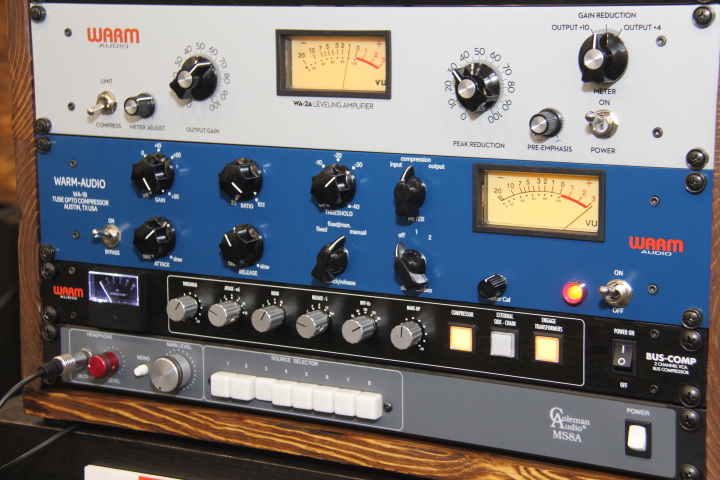
“The WA-1B is our newest compressor. It’s a tube optical compressor like our WA-2A, but what’s different about it that’s awesome is that it has more external controls. It has external attack and release. With the WA-2A, you have peak reduction and level, but with the WA-1B, you can actually control the internal parts of the compressor, deal with threshold ratio. It’s really big with R&B, Hip Hop, and rap: Kendrick, Kanye, Drake, Jay Z—that classic stuff,” eloquently explained Matt “Dez” Desilet, Product Marketing Manager, Warm Audio. “The WA-2MPX [which we unveiled at NAMM last year] is based on the Ampex 351 that was a tape machine [style] pre-amp, that’s kind of first on the chain: plug your mic into that, then the compressor is next, that’s controlling your volume chain. Say you’re a real dynamic singer and you were getting loud, getting quiet. What’s hard with recording, right? You want to make sure the volume is even so you can mix better later, but you don’t want to suck all the tone out. So, what the WA-1B does, it gives you all that sweet tone, so the tone stays in. You know plug-ins, I love plug-ins, but when you do a lot of compression it takes the tone away. This [the WA-1B] keeps it there. I call it our goldilocks; it’s our middle compressor. So, if you have the WA76, our black one, or our WA-2A, our gray one, this one is the best of both worlds. It’s really great on drums, bass, vocals, spoken word, and voice over, is really good for that too. It’s amazing on guitars too, especially acoustic or the mic from the cabinet.“
Another company who had their presence felt was Wolff Audio, based among other things on their new and very impressive Propatch 128 all-relay automated PatchBay solution for Pro Audio.
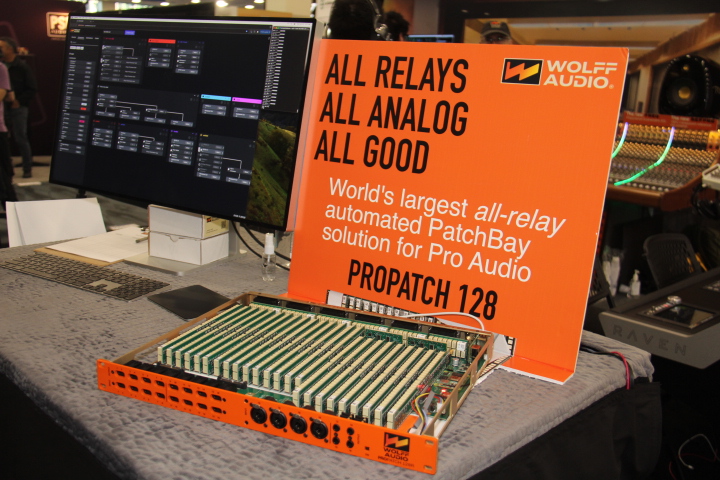
“This is a 64-input, 64-output digitally controlled analog patch bay. It uses an all-relay system and is completely passive in the audio path, meaning there’s nothing that touches your audio. It is controlled by a web app. It will also store all your presets. This one we’re looking at, the 64×64, is ten thousand dollars; we also have a 32×32, which is around the four thousand range,” explained renowned recording audio engineer Jim Mikles, who, along with partners Jared Vogt and Paul Wolff, founded what is highly praised and known as Wolff Audio.
Another company also highly praised, among other things, for their AD/DA converters, is Lynx Studio Technology, which was unveiling their next-generation two-in, six-out AD/DA Hilo 2 audio interface/converter.
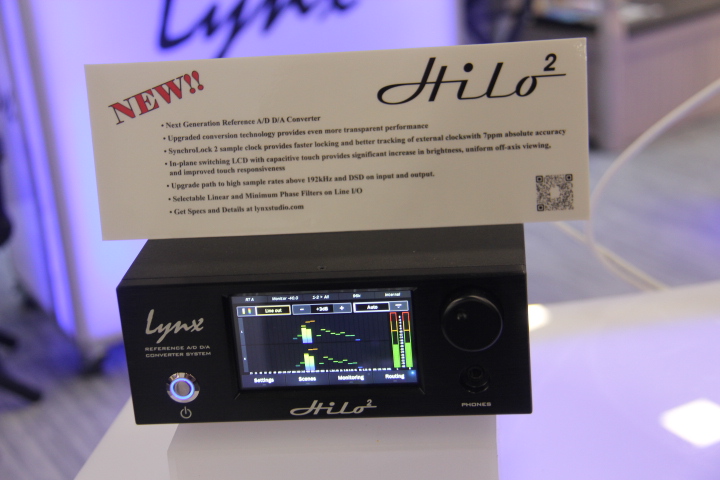
“The Hilo 2, we didn’t want to start from scratch because the Hilos were so successful for us. We wanted to make improvements that matter. So, the things we focused on — we have new converter chips: a little better audio performance on the line-ins and outs, a little bit less distortion, a little better dynamic range. We made the clocking we perfected in the Aurora, we applied that to the Hilo 2, so it’s a more accurate, precise clock than even on the old one, so those are sonic things that improve it,” eloquently pointed out Paul Erlandson, Director of Product Support, Lynx Studio Technology. “We also give access to different filters, so if you want the behavior of the roll-off to be a little different, to have the transients be a little sharper, there are going to be like eight different settings you can try there: there are different characters you can get out of it as well. We have also changed the screen. In the old screen, it was based on pressure; the new one is based on capacitance, the electrical charge on your fingers, so it’s more responsive. It works more like your cell phone, it’s brighter, cleaner looking, so off-axis feeling is a lot better as well. We didn’t want to mess with the formula since it was so successful; we wanted to do stuff that’s really going to help. It’s really our best performing conversion with smaller channel count. So – it’s not for everyone. If you need eight channels of analog channels, the Hilo 2 is not your guy.”
Amphion Loudspeakers Ltd. was another booth that definitely caught my attention, which, among other things, was displaying a box cut out of a very unique three-way active studio monitor.
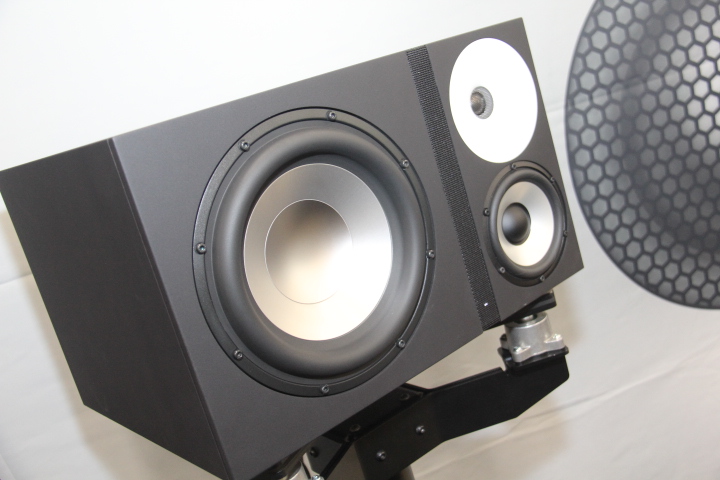
“Our Amphion One25A is a new active monitor, something we’ve been working on since 2019, so we’re four years into R&D. It’s a fully sealed three-way active monitor; we have dual sealed cabinets. We separated the bass unit from mid-range and tweeter. We are using a new tweeter and mid-range in the speaker. We also have separated the electronics outside the box, which are in a heavy steel enclosure; it houses the power supply and tri-amps for bass, treble, and mid-range, which are also removable for soffit-mounting applications,” eloquently explained Julian Hyvonen, Marketing Manager, Amphion Loudspeakers Ltd. “The One25A monitors are very much an addition to the Amphion family instead of being its own individual product, so we still use similar design principles as in the rest of the line — so we have a low cross-over point, waveguide design, and time-aligned drivers. We also use a very simple and pure signal path; we don’t use any DSP or any unnecessary AD/DA conversion; that way, we get the maximum resolution out of the product as well. We use the nice part of active design, so it protects the circuits as well as eight filters, and we have applied boundary controls, eight-step boundary controls so you can adjust the bass under 150Hz, from -7dB to +7dB, and that works for soffit mounting and placing close to boundaries.”
In my view, NAMM deserves praise—alongside outgoing President and CEO Joe Lamond for his two decades of dedication—for choosing to hold the in-person show for a third consecutive year. This decision demonstrates their unwavering commitment not only to the participating companies and the event itself but also to the music fans and general public who attend. Like many others, I eagerly look forward to NAMM regaining its former prominence, and returning the show to its traditional January schedule this year feels like a promising first step.