
By: Fredwill Hernandez
The 122nd National Association of Music Merchants (NAMM) Show, which ran from Thurs., April 13 through Sat., April 15, returned for the second time in-person without any COVID-19 restrictions with “mixed emotions” from attendees. Many were disappointed with the show’s size and turnout, while others, like myself, were just glad NAMM returned — even if it was back with baby steps, in hopes future NAMM shows will eventually regain momentum and return to their glory days.
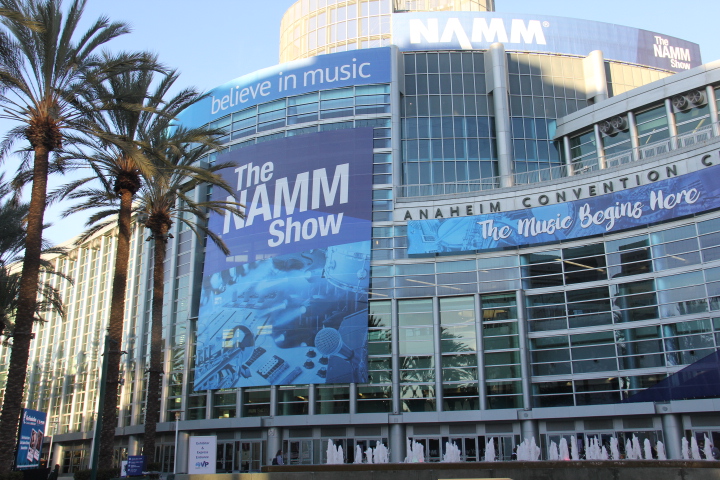
Absent from the show were companies like Gibson, PRS, KHS, America’s Hohner [accordions], and countless others who, according to NAMM, represented “a 50% drop” from the 7,000 brands that exhibited in 2020, during the last in-person show before the pandemic. A notable difference this year was “the size” of some previous show booths, “their location,” and even though the floor plan allowed more space between booths – a pandemic precaution – it was obvious there was “much less foot traffic.” There were 115,000 attendees in 2020, and this year there were only 46,711, and 1,200 exhibitors representing roughly 3,500 brands versus 7,000 brands that exhibited in 2020, the last year the show was held, pre-pandemic.
On the flip side, companies like Shure, Apogee Digital, Warm Audio, Lynx Studio Technology, and a few others took advantage of the in-person show’s return by being able to personally interact with attendees and their customers.
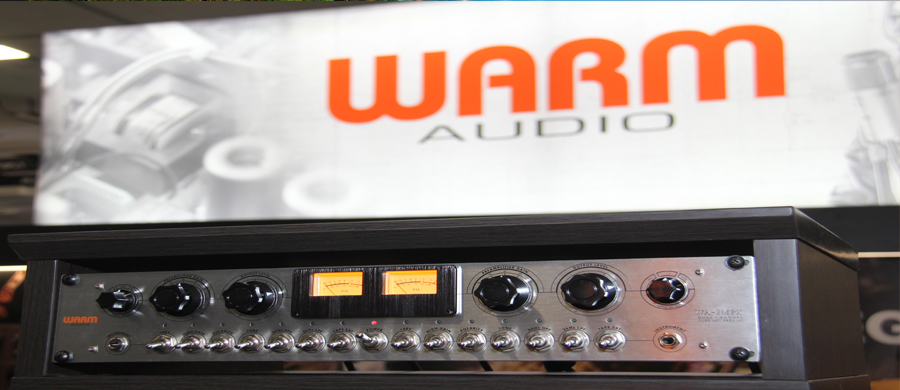
For a second straight year, there was a “buzz” surrounding Warm Audio’s booth. This year was based on their new and very impressive WA-2MPX dual-channel reproduction of the “most revered microphone tube preamp,” featuring premium components and true-to-original circuit design for iconic analog warmth and tape-era tube tone.
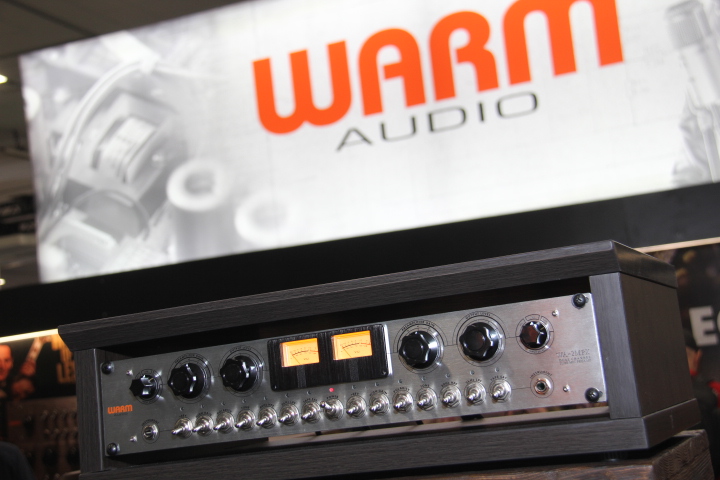
“Our WA-2MPX is based on the old 351 style preamp from Ampex which used to be at Sun Studio, and RCA [studio] back in the day, used on records by Nat King Cole, Elvis Presley, Roy Orbison and all that stuff. Then from the 50s, after that when newer stuff would come out those would get thrown away in the junk. What people would do is take the old preamps from the [Ampex 351] tape machines and re-wire them, and “reuse them” in the studio,” eloquently explained Matt Desilet, Product Marketing Manager, Warm Audio. “A lot of those tape machines [also] ended up going to second hand studios which couldn’t afford the newer stuff that was coming out [at that time] in the 60s. So, all these artists recorded and used them, since everyone loves the sound of tape — right, that’s a big deal: 90db of gain, a ton of gain, you can run ribbon mics through them and get them cleared, low out dynamic mics, it sounds killer, and then you can also run “all your audio through them to get the tape sound.”
In order to “precisely deliver” original tube character, the WA-2MPX is hand-assembled with “three premium tubes per channel” paired with custom wound true-to-spec transformers which, according to Warm Audio, are made in partnership with component manufacturer CineMag.
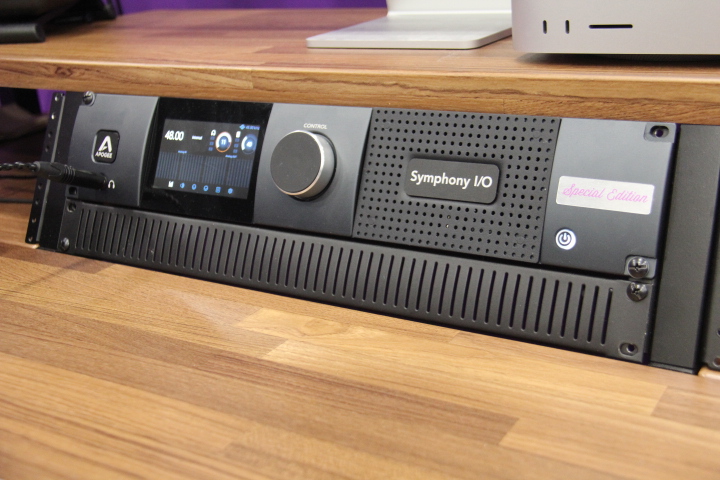
With Dolby Atmos and other 3D immersive mixing formats quickly becoming “the newest trend,” Apogee Digital’s booth also had some new, cool, and impressive gear like its Symphony I/O MK II 16 x 16SE – its plug and play Thunderbolt Monitor Workflow. According to Apogee Digital, one can effortlessly configure their monitoring system for either Dolby Atmos, Sony 360 Reality Audio, and other immersive audio systems – allowing up to 16 Monitor Workflows in all popular multi-channel configurations from Stereo to Atmos 9.1.6 – which can control up to 32 speaker outputs without the need for a separate studio monitor controller. It has fewer parts than its predecessor, Symphony I/O MK II unveiled at NAMM 2022, while also running much cooler in overall temperature – which, in my opinion, is very cool and a game changer.
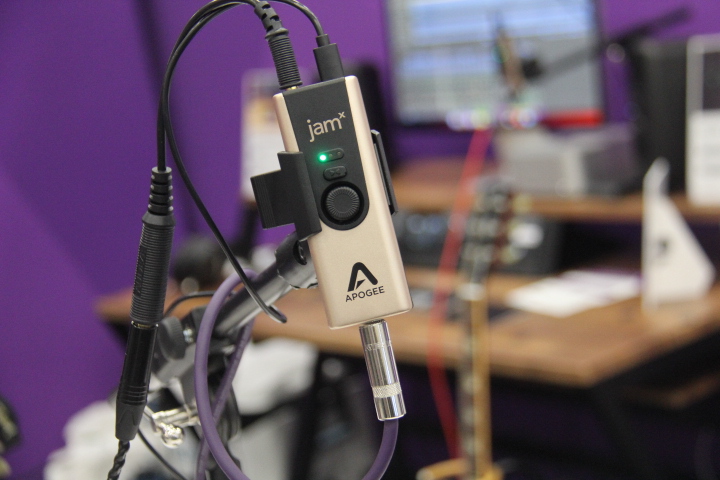
For the producer, musician, or recording artist “on the go,” Apogee Digital [also] unveiled the [next generation] plug-and-play mini jamX, a [mobile] USB audio interface optimized primarily for guitar [and instrument] recording that features a built-in analog compressor allowing the user to shape their tone, or the ability to also use three presets: Smooth Leveler, Purple Squeeze, and Vintage Blue Stomp – to dictate how much they can drive the input gain, from subtle to extreme.
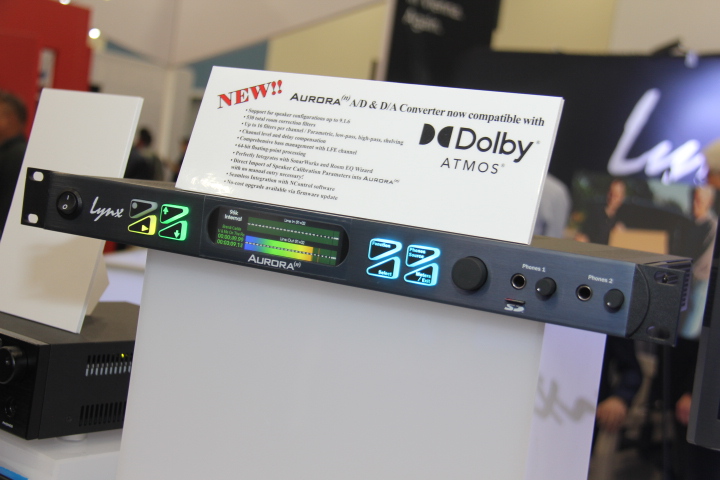
In order to keep up with and cater to Dolby Atmos and other 3D [immersive] mixing formats, Lynx Studio Technology announced compatibility between their “highly praised” and popular Aurora audio interface/converter and Atmos. This free firmware update, available through their website, includes support for speaker configuration up to 9.1.6, 530 total room correction filters, up to 16 filters per channel, channel level and delay compensation, and comprehensive bass management with LFE channel, all of which are implemented in hardware with 64-bit floating point accuracy.
Among a few items unveiled by Antelope Audio, aside from their MRC or its Orion 32+ [Gen 4], was their “new and very impressive” Atlas i8 Isobaric Active Monitor Speakers, which offer transparent and accurate sound combining the finest technologies used inside their master clocks and audio interfaces together with meticulous acoustical engineering — to achieve truly accurate sound for precise mixing and production decisions. Due to its isobaric design [of two identical 8” woofers one behind the other], and coaxial mid/high drivers, the Atlas i8 is capable of producing tight and coherent frequencies down to 35Hz with ease. The custom-designed Class-D amplifier with incredibly low THD, tailored exclusively for the Atlas i8, feeds 200W to the 8-inch woofers, 100W to the mid and 100W to the high-frequency drivers to ensure substantial high [117dB max peak] SPL performance per speaker at 1m.

“Its software control panel via USB will enable the full potential of the Atlas i8. The onboard processing allows manual frequency adjustments, allowing improvement of the overall performance of the speaker based on room acoustics. Other workflow-enhancing options like dim, mute, volume control, and delay offset will also be available,” eloquently explained Momchil Shishkov, Product Manager, Antelope Audio, during NAMM Preview Day. “The monitors boast a 4-band equalizer, in which corrections can be made from the color display on the back to adjust volume, routing, and also recall EQ presets with ease by a simple 4-band equalizer, allowing one to also reduce the low band to improve the bass response in your room or the high frequencies to avoid desktop reflections. The monitors have AES/EBU in and out digital input and outputs to provide wider connectivity options, bypassing conversion in the interface and daisy-chaining the two monitors with ease, and can also come with an optional mounting plate, making wall/ceiling placement for multi-speaker immersive and Dolby Atmos surround setups possible.
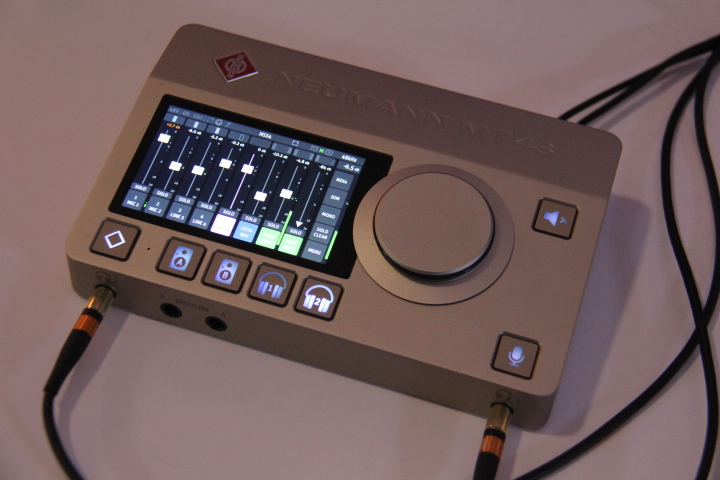
Neumann also took advantage of this year’s NAMM to show off its “first-ever audio interface” promising to bring out the full fidelity addition to its world-class microphones, monitors, and headphones. With an intuitive easy-to-use touchscreen interface, ample digital signal processing (DSP) resources that include a fully parametric 4-band EQ and a three-way dynamics processor (gate/compressor/limiter) per channel, as well as a high-quality reverb and flexible expansion options, the Neumann MT 48 is a perfect choice for any music enthusiast or creator who values pristine sound quality and eventual scalability.
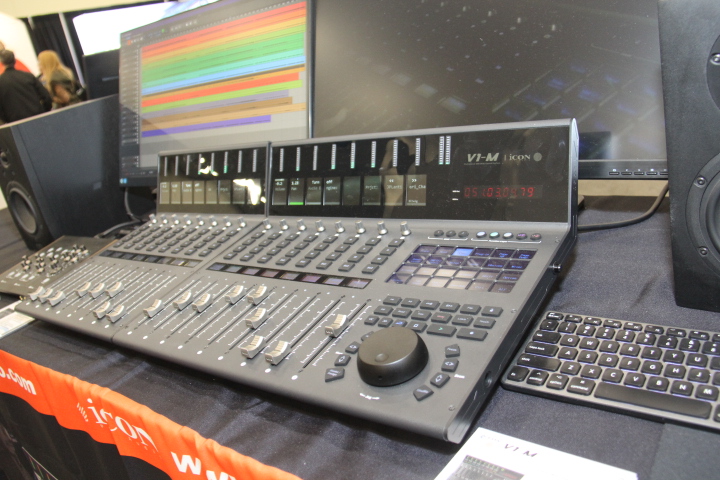
Icon Pro Audio, who among other things also unveiled the V1-M controller which uses a touchscreen control system with five layers – and can be configured, controlled, and programmed with its iMAP software, allowing you to switch quickly between up to three DAWs. The V1-M controller has motorized touch-sensitive faders running at 12-bit resolution and a nicely visible premium OLED screen metering display. It’s also equipped with a nice and heavy jog wheel which feels really good, a timecode display, and the controller can also be extended for more faders via its V1-X extender according to your DAWs’ need or your personal preference.
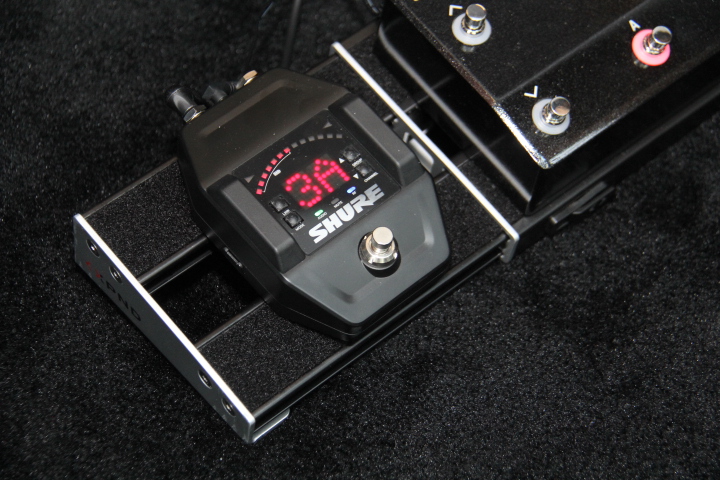
Shure [Mic’s] booth “never disappoints.” This year was no different — by unveiling the new and impressive GLX-D+ Dual Band Wireless System, providing a solution for anyone [musician, vocalist, or presenter] who desires to go wireless with ease. The GLX-D+ doubles the available bandwidth and is able to operate in [both] 2.4 GHz and 5.8 GHz frequencies, providing a consistent and reliable signal, and also “automatically scanning” for the best and cleanest frequencies, therefore avoiding interference and dropouts. The cool wireless system is available as a rack mount, tabletop, or guitar pedal — with the options of a headset, lavalier, or a handheld microphone [such as SM58, BETA 58A, or BETA 87A models], and it also boasts an “improved battery life” of 12 hrs., or 1.5 hours after just 15 minutes of charge time.
NAMM [in my opinion] “needs to be commended” for not only deciding to bring the [in person] show back for a second straight year, which not only shows “their relentless commitment” to the companies that partake and the show itself, but is equally important to the music enthusiasts and general public who attend. Many among myself highly anticipate NAMM returning to its glory days; having the show return to its original January dates in 2024, I feel, “is a start.”